
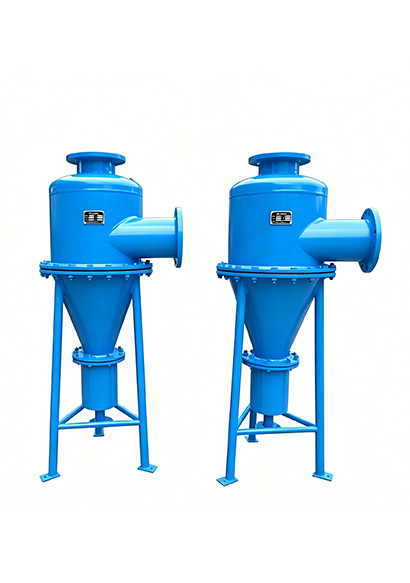
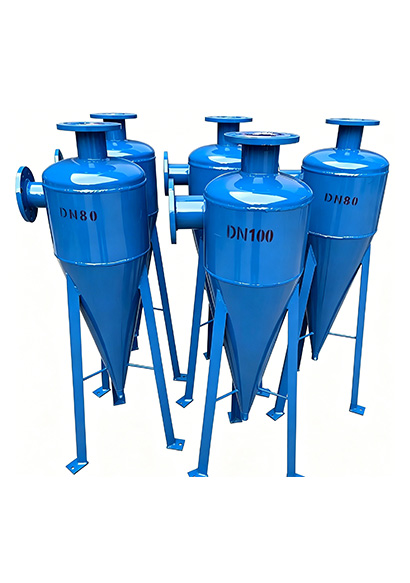
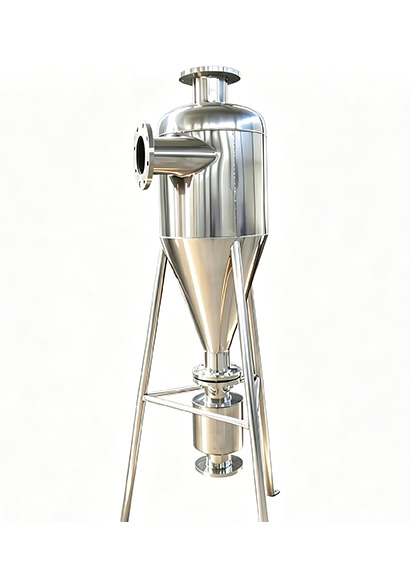
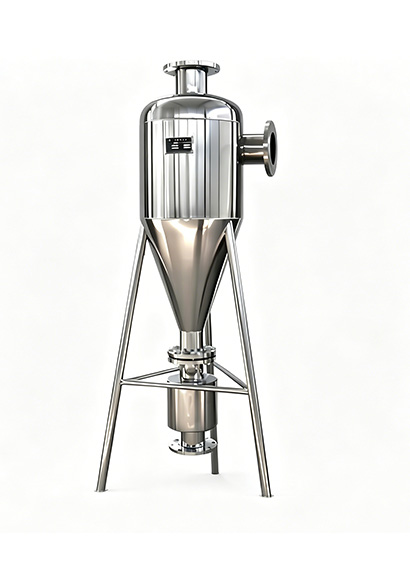
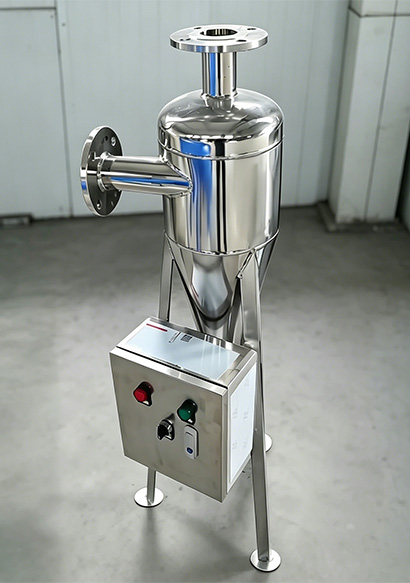
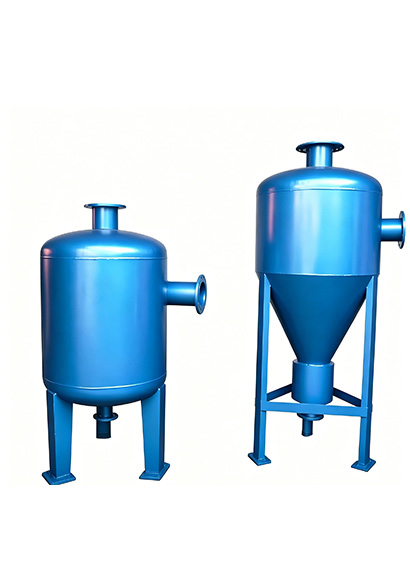
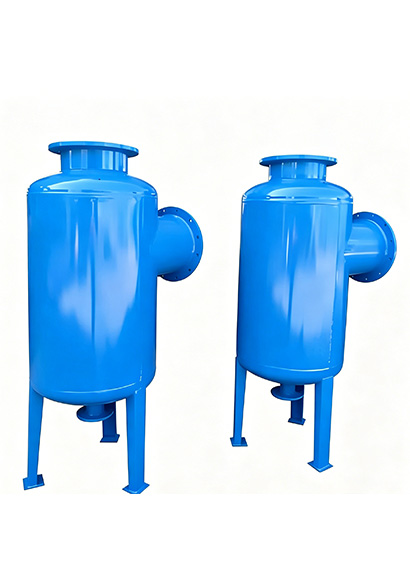
A cyclone sand separator is a physical separation device that uses the principle of centrifugal sedimentation to efficiently separate solid particles such as sand and stone chips from water. It requires no consumables and relies entirely on the water's own pressure to "spin out" sand. It is ideal as a "protective shield" for water source heat pumps, central air conditioning systems, and more, preventing pipes and equipment from being worn or clogged by sediment.
Email:
xxhuaqing@126.comPhone:
+86 15936525232Simply put, it uses centrifugal force to separate heavy sand from lighter water.
1. Tangential Inlet Flow: Sand-laden water enters the equipment at high speed from the tangential direction on the side, forming a rapidly rotating vortex inside the cylinder.
2. Sand-Water Separation: Under strong centrifugal force, sand particles (heavier than water) are thrown against the cylinder wall, spiral down along the conical inner wall, and finally settle into the sand collection hopper at the bottom.
3. Clean Water Discharge: The cleaned water forms an upward inner vortex at the center and exits through the top outlet, completing the separation process.
When choosing a model, focus on these three core indicators, which directly determine whether the separator will work effectively in your system.
|
Parameter |
Description |
|
Flow Rate |
Single unit typically handles 5–400 m³/h. For systems with very high water volumes, multiple units can be installed in parallel. |
|
Separation Efficiency |
Effectively removes particles larger than 0.08–0.1 mm, with a sand removal rate of 90%–96%. For ultra-fine suspended solids, it is usually used in combination with a fine filter. |
|
Pressure & Temperature Rating |
Standard working pressure: 0.2–0.4 MPa (requires matching water pump). Temperature range: -5℃ to 135℃, covering most industrial and civil applications. |
Low Cost & Maintenance-Free: With no moving parts like motors or impellers, it operates purely via physical separation, resulting in near-zero energy consumption. It requires almost no daily maintenance, except for occasional draining of collected sand, keeping operating costs extremely low.
Compact Footprint: Compared to traditional sedimentation tanks, it has a very small footprint and minimal installation space requirements, making it ideal for machine room renovations or projects with limited space.
HVAC Systems: Protect heat exchangers in water source heat pumps and central air conditioning circulating water systems from erosion.
Industrial Circulation Water: Pre-treatment of cooling water in chemical, power, and steel plants.
Municipal & Agricultural Use: Initial purification of river water, well water, and geothermal water.
| Sand Filter Model | Flow Rate (T/h) | Water Inlet (mm) | Water Outlet (mm) | Cylinder Diameter (mm) | A1 (mm) | B1 (mm) | B2 (mm) | H1 (mm) | H2 (mm) | H3 (mm) |
| YLXC-40I | 25 | 40 | 25 | 273 | 220 | 113 | 220 | 640 | 140 | 850 |
| YLXC-50I | 40 | 50 | 25 | 273 | 220 | 108 | 230 | 680 | 140 | 910 |
| YLXC-65I | 50 | 65 | 25 | 325 | 220 | 124 | 240 | 780 | 140 | 1030 |
| YLXC-80I | 60 | 80 | 40 | 325 | 220 | 118 | 250 | 830 | 180 | 1095 |
| YLXC-100I | 100 | 100 | 40 | 377 | 220 | 134 | 250 | 920 | 200 | 1205 |
| YLXC-125I | 160 | 125 | 50 | 377 | 320 | 122 | 300 | 980 | 200 | 1310 |
| YLXC-150I | 200 | 150 | 50 | 478 | 380 | 150 | 360 | 1010 | 200 | 1410 |
| YLXC-200I | 250 | 200 | 50 | 620 | 440 | 200 | 430 | 1065 | 200 | 1550 |
| YLXC-250I | 300 | 250 | 65 | 720 | 500 | 225 | 520 | 1170 | 200 | 1750 |
| YLXC-300I | 500 | 300 | 65 | 820 | 580 | 274 | 590 | 1375 | 250 | 1990 |
